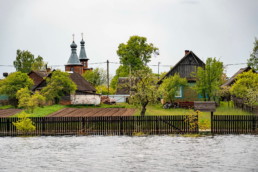

Explore Polesia’s natural treasury! Find all protected areas in one interactive map
Polesia is a vast and valuable wilderness area where many natural systems have been preserved in a natural or near-natural state. Across four countries it covers an area of around 18 million hectares, of which approximately 1 million are protected due to their high conservation value. We have developed the first interactive map of Polesia’s natural protected areas, which allows users to explore the sites with different protection statuses, as well as to assess our project’s contribution to the expansion and strengthening of the protected-areas network.
A significant share of Polesia’s natural areas is under different forms of protection. Some areas are protected at national level, whilst others are recognized as being of international importance (Ramsar Sites, Emerald Network sites, etc.). Nevertheless, we are still far from being able to say that Polesia’s natural heritage has been fully studied and mapped, or that all areas of conservation importance are adequately protected.
Over several years, our project experts have studied some of the most valuable natural areas of Polesia. They have gathered information on natural complexes and habitats of rare species, proved their conservation value, and lobbied for securing protected status to such areas and sites in accordance with national regulations and legal procedures. As a result of this painstaking work, more than 105,000 hectares of new areas in Belarus and Ukraine have been granted protection status.
Different areas and sites required different approaches. With the involvement of our project, new protected areas were designated, including Pushcha Radzivila National Park in Ukraine and the Lva Floodplain and Starobinsky nature reserves in Belarus. In other cases, existing protected areas were expanded. The most striking example of the success of this work is the expansion of the Almany Mires Nature Reserve in Belarus by 10,000 hectares. These efforts have not only increased the size of protected areas but have also enhanced their ecological connectivity. Research carried out as part of our project shows that this is vital for improving habitats quality for large mammals, in particular the grey wolf and the Eurasian lynx.
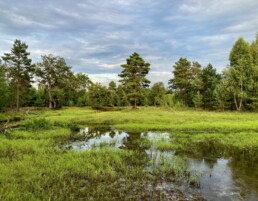
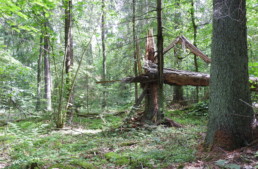
The experience of scientists and conservationists shows that Polesia remains largely unexplored and therefore often holds surprises: valuable natural sites that require urgent conservation measures continue to be discovered here. These are often isolated sites covering a small area, for which it is not practical to establish a new nature reserve or national park. In Ukraine, such sites can be designated as natural monument. One notable success of our project was the discovery and protection of Makove Bog, a primeval forest that was previously unknown and had no legal protection. Thanks to its designation as a natural monument, this exceptionally valuable site has been saved from destruction by peat extraction.
In Belarus, there is a practice to place individual habitats of Red Data Book species under protection. Conservation measures for such sites are the responsibility of land users, and they are mandatory. During fieldwork to monitor biodiversity carried out prior to 2022, our specialists identified hundreds of habitats of rare flora and fauna species, which were subsequently placed under protection.
In addition to the habitats of rare species, Polesia is home to a rich diversity of rare and typical biotopes that also require protection. In Belarus, it is possible to place such areas under protection regardless of whether they are situated within or outside an existing protected area. It is important to note that, in most cases, the specific conservation measures for an individual biotope are stricter than the general regulations applying for a protected area as a whole. Therefore, this makes biotope-level protection a particularly effective form of conserving natural complexes.
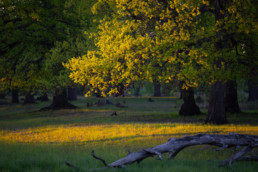
Further landscape research and biodiversity monitoring are essential for strengthening nature conservation in Polesia. The presence of rare and typical biotopes, as well as a rich diversity of species, including rare species, provides a strong scientific basis for designating new protected areas and expanding existing ones.
Our interactive map allows exploring our project’s contribution to the expansion of the protected-areas network in Polesia. We suggest viewing it not in isolation, but in the context of the wider system of areas with national and international protection status. The map demonstrates how newly protected areas have strengthened ecological connectivity and shows opportunities for continuing this work in the future through well-reasoned and targeted efforts.
We have paid particular attention to the key areas with which our project has worked closely. Each of these areas has its own page, providing a detailed description of its natural values and the project activities carried out there.
We hope that the interactive map will be of interest and use not only to scientists and conservationists, but also to anyone who cares about the immense natural heritage of Polesia.