
Now on to action! The first phase of restoration work on the Osliv River is on.
This summer, we started implementing an action plan to improve the hydrological conditions within the Osliv River watershed. This river flows through the Drevlianskyi Strict Nature Reserve, a protected natural area possessing a number of specific characteristics that make our work, on the one hand, even more important, and on the other, more challenging.
The Drevlianskyi Strict Nature Reserve (SNR) is one of our key project areas that borders the Chornobyl Exclusion Zone. One of the most significant characteristics of this protected natural area is its high level of radioactive contamination. This largely determines the methods of the restoration work being carried out in the reserve.
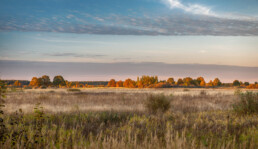
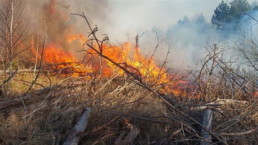
In the past, extensive land reclamation systems were built in this area. Their drainage effect was enhanced by the landscape’s features: steep ground slope accelerated the outflow of water. Today, this excessively dried-out area suffers from frequent fires. Sometimes they occur naturally. However, the problem is exacerbated by the war: large numbers of military drones fly through the reserve’s territory. Some of them crash within Drevlianskyi, while others are intercepted and destroyed in flight, with falling debris potentially causing wildfires. Flames spread easily across dry terrain, and especially through pine forests, which burn easily. Peatland fires are especially difficult to distinguish. In 2023, a fire broke out on a peat bog within the nature reserve; it could not be extinguished for an entire year because the smoldering continued within the thick layer of peat even during rainy weather and as the snow melted. Fires in the Drevlianskyi SNR pose an additional hazard due to the heavy contamination: radioactive particles are carried into the air by smoke and can be spread by the wind over significant distances.
Dmytro Kondratyuk, Deputy Director for Scientific Work at the “Drevlyansky” Nature Reserve:
«The restoration of the wetland ecosystems in the Drevlyansky Nature Reserve is not only a matter of biodiversity conservation but also a crucial component of public safety. Our reserve is located in a border region that was directly affected by the military operations of 2022, so increasing the resilience of the territory is of particular importance. Land reclamation and drainage have led to a drop in the water table, a loss of biodiversity, the drying up of peatlands, and an increased risk of large-scale fires. Restoring the natural water cycle is one of the most effective conservation measures, helping to reduce the risk of wildfires, increase the landscapes’ ability to retain water, and restore natural ecosystems. In the context of war and climate change, this is not merely a conservation effort but an investment in the environmental sustainability and security of our region.»
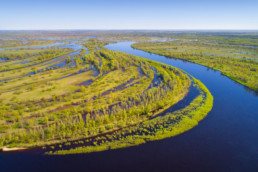
Among the water bodies in the Drevlianskyi SNR that have been disturbed by land reclamation is the Osliv River. The impact of drainage canals has drastically transformed this river: it has become extremely low in water flow. By now, we have focused our efforts on primary measures to improve the water regime within the Osliv River watershed. This area is located only a few kilometres from the small town of Narodychi, which is frequently affected by wildfires. In particular, a large-scale fire broke out near the town following a drone attack in late August 2026: at that time, rescue workers, together with staff from the nature reserve, spent several days fighting the blaze.
Taking into account the findings of preliminary studies, the ongoing risk of wildfires associated with the war and the area’s close proximity to a settlement, as well as the specific characteristics of the area, and relevant laws and regulations, we have decided to begin with priority measures that are relatively simple to implement and, at the same time, are expected to yield results fairly quickly.
Thus, the first stage of the practical work involved the installation of 30 floodgates, wooden barriers designed to retain water flow. They emerged in areas where they were originally envisaged by land reclamation project to regulate water flow but had been damaged or destroyed. The former structures provide practical locations for installing the new wooden barriers, including by allowing them to be attached to or integrated with the existing remnants.
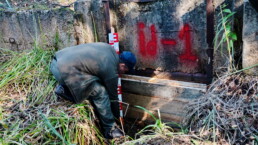
However, the purpose of the new barriers is not to restore the original water-regulation function of the former floodgates. Rather, they will effectively close or obstruct the drainage channels at these locations, slowing water outflow and thereby increasing water retention in the surrounding area. The main objective is to reduce the impact of the drainage canals in the most sensitive areas, where these measures are expected to be effective, namely, contribute to greater moisture retention and a wildfire risk reduction.
Based on our preliminary assessment, we expect to see the first results quite soon: they may be noticeable this fall already, when rainy weather sets in. For now, this will be a localized effect: some areas will experience more flooding during the season, and in some places the groundwater level will rise slightly. However, even this modest progress is very important.
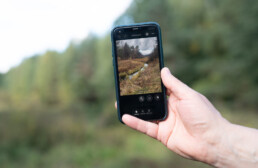
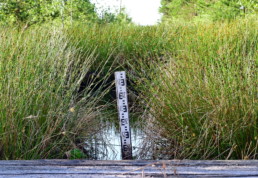
To assess this effect, we are implementing automatic, semi-automatic, and manual hydrological monitoring. At some sites, we install divers, automatic devices for measuring groundwater and surface water levels, while at others, we also install measuring rods to be able to compare the data from automatic and manual measurements.
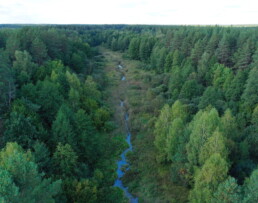
As mentioned above, the work carried out so far represents the first steps toward the comprehensive ecological rehabilitation of the Osliv River. In a next step, we are planning to develop and obtain approval for a much larger-scale project aimed at optimizing the hydrological regime of the Osliv River watershed. This work requires an engineering plan and an environmental impact assessment taking into account the protection status and radioactive contamination of the area. The long-term goal we are striving for is the comprehensive ecological restoration of the Osliv River. This will be a significant contribution to the preservation of the valuable ecosystems of the Drevlianskyi SNR and to maintaining fire safety in the area.



The project “Polesia – Wilderness Without Borders” is part of the Endangered Landscapes & Seascapes Programme and is funded by Arcadia. The project is coordinated by Frankfurt Zoological Society (FZS).