

Wildlife in Chornobyl is changing its behaviour during Russian invasion
An international research team has for the first time investigated how an unfolding armed conflict influenced the behaviour of wild animals. Using camera traps, the scientists documented how the Russian occupation of the Chornobyl Exclusion Zone during the 2022 war in Ukraine affected the activity of the animals living in the area. Data analysis shows that red deer, roe deer, foxes, and wild boar adjusted their day and night activity to the hostilities during this period. The team led by Dr Svitlana Kudrenko, who earned her PhD at the University of Freiburg, and Prof. Dr Marco Heurich of the University of Freiburg has published its findings in the prestigious journal Science. The paper is based on the data collected as part of an unprecedented large-scale camera trap survey carried out as part of the ‘Polesia – Wilderness Without Borders’ project.
Dr. Svitlana Kudrenko conducted this study as part of her doctoral research at the Chair of Wildlife Ecology and Conservation Biology at the University of Freiburg and while working as a research fellow at the Frankfurt Zoological Society.
Marco Heurich is a professor of wildlife ecology and conservation biology at the University of Freiburg. His research focuses on applied ecology, conservation, and remote sensing, with a particular emphasis on the role of large mammals in ecosystem processes.
Prior to the occupation, Svitlana Kudrenko and Marco Heurich had already used camera traps in the Chornobyl Exclusion Zone in 2020 and 2021 to study how human activity affects landscape features, biodiversity, and the likelihood of animal habitation. The researchers set up camera traps at 174 locations in the Ukrainian part of the Chornobyl Exclusion Zone, as well as in six protected areas and unprotected areas along the Belarusian-Ukrainian border.
“Our findings show that the diurnal activity patterns of mammals, particularly their nocturnal activity, changed during intensifying armed conflict. This points to a broader transformation of the Chornobyl Exclusion Zone — away from an ecosystem that, in the absence of human disturbance, had recovered from the reactor disaster, toward a militarised landscape in which wildlife habitat use and behaviour changed,” says Marco Heurich.
An unintended scientific experiment amidst the Russian invasion
The Chornobyl Exclusion Zone covers an area of 2,600 km². Following the 1986 nuclear disaster and radioactive contamination, most of the area was designated a biosphere reserve.
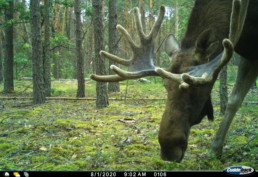
“The minimal human presence in the zone enhanced an increase in wildlife populations and led to recolonization of the area by species that had become locally extinct before the catastrophe — such as brown bears and lynx — or those that were found only in small numbers, such as moose, red deer, wild boar, and gray wolf” explains Kudrenko.
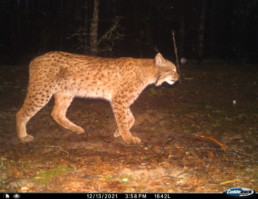
Russian forces occupied the Chornobyl Exclusion Zone for 36 days, from February 24 to April 1, 2022. Since 2021, scientists had been monitoring a lynx population there using camera traps. After the end of the occupation, the team realised that the tragedy of war offered a chance to ask a new research question: How exactly did wild animals react to the immediate presence of armed conflict? “Alongside our original research project, we were also able to investigate what had previously only been studied in military training areas,” says Heurich. Following the withdrawal of the Russian forces, researchers were able to recover data from 31 camera traps, with the aid of Ukrainian armed forces who cleared mines and secured the area.
Analysis reveals link between conflict intensity and species-specific behavior
Remote camera traps, which are triggered by passive infrared sensors, continuously recorded images from January 19 to May 6, 2022 — that is, immediately before, during, and after the occupation. As the basis for their analysis, the researchers compared this data with images from the 31 camera traps and an additional 25 camera traps from the previous year prior to the invasion between January 19 and March 21, 2021.
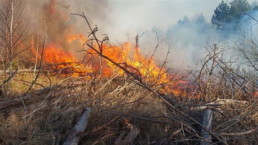
In a further analysis, the team assessed the daily intensity of the armed conflict in 2022 and compared it to the animals’ daily activity patterns. “To do this, we derived an index of conflict intensity based on interviews, including those with employees of the nuclear plant. In this index, we rated events such as military convoys, live firing, airstrikes, artillery shelling on a scale from 0 to 10. We also took into account other factors, such as precipitation, proximity to roads or areas with a permanent human presence, and thermal anomalies such as bombardments or forest fires,” explains Kudrenko.
As conflict intensifies, animal activity during the day increases
Using the data, researchers studied the behavior of eleven animal species. “We initially assumed that, in response to disturbances caused by the armed conflict, animals would become more nocturnal, vigilant, and would avoid places with a constant human presence. Such behavior has already been documented, and we had assumed that it would intensify during the armed conflict.”
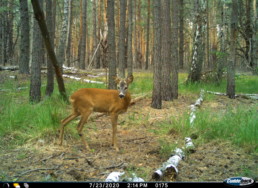
While this was true for some of the species studied, the researchers also observed species-specific behaviours that deviated from previous assumptions: red deer and red foxes reduced their nocturnal activity during the occupation compared to the same period the previous year. “The decline in night-time detections suggests that these species have shifted their activity to daytime hours in response to increased conflict intensity,” says Kudrenko. “Overall detections of roe deer declined while overall detections of red deer increased amid rising conflict intensity. We also observed that brown hare and red deer responded to thermal anomalies, mainly conflict-related forest fires, by becoming more active at night.”
Not all the species studied avoided areas near human infrastructure. Regardless of the intensity of human-wildlife conflict, the researchers were more likely to detect wild boars and raccoon dogs only at a greater distance from permanent human settlements. They were more likely to find red foxes and lynx near these locations. “Our study underscores the critical role of general and systematic monitoring of wildlife in protected areas and beyond.”
The article was originally published on Freiburg University website.





The project “Polesia – Wilderness Without Borders” is part of the Endangered Landscapes & Seascapes Programme and is funded by Arcadia. The project is coordinated by Frankfurt Zoological Society (FZS).