

Exploring the Chornobyl wilderness: our experience of research and restoration in the exclusion zone
Forty years have passed since one of the worst man-made disasters in history occurred – the accident at the Chornobyl nuclear power plant. The tragedy led to the creation of the Exclusion Zone – an area that is almost entirely abandoned by people. For all these four decades, wildlife has been reclaiming the once-inhabited territories without human guidance or intervention. Today, the Chornobyl Exclusion Zone is one of the most scientifically interesting areas in Polesia. For several years, our project has been involved in studying this territory, and now we are preparing to restore the wetlands within the Chornobyl Exclusion Zone.
26 April 1986 – a date that tragically and irrevocably changed the lives of tens of thousands of people. At the same time, from that very moment, an unplanned yet in many ways unique experiment began: the territory abandoned by people was left to the mercy of the wild. If there is one positive aspect to be found in the aftermath of this terrible accident, it is that it has shown us: wildlife will thrive if given enough space and time. It is a pity that we have had to pay such a high price to prove this point.
What processes have been taking place in the Chornobyl Exclusion Zone since then? How have ecosystems developed under conditions of radioactive contamination, yet with the almost complete absence of human impact? How has the landscape changed, and how are the species inhabiting it faring? Scientists from various countries continue to ask these questions and meticulously collect data to find the answers. We, too, are making efforts to research and conserve the wildlife in the Chornobyl Exclusion Zone.
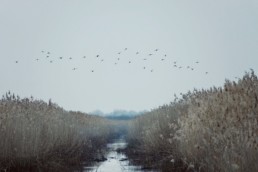
Shedding light on the Chornobyl wildlife
In 2021, we supported the study that had lasted for 22 years: Belarusian and British scientists analysed the data on raptor species in the Chornobyl Zone collected over this long period. Their findings were impressive: as a result of a ban on economic activities in the formerly intensively used areas, the wetland area increased by 680% from 1999 to 2017, and the forest area by 14%. The change in the landscape entailed the transformation of animal communities. For instance, neither the globally endangered Greater Spotted Eagle (Clanga clanga) nor the White-tailed Eagle (Haliaeetus albicilla) could be found in what is today the Chornobyl Exclusion Zone before the accident. However, these species, both highly sensitive to human disturbance, are now found in the exclusion zone, and their populations are growing.
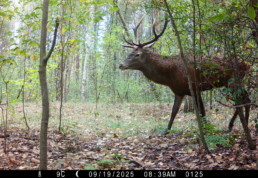
In 2020–2021, as part of our project, camera trap monitoring of large and medium mammals in the Chornobyl Radiation and Ecological Biosphere Reserve (Ukraine) was carried out. It was the most extensive and systematic survey of its kind attempted in this area: camera traps were deployed across more than 200,000 ha. The monitoring enabled scientifically grounded estimation of densities and abundances across multiple mammal species. The survey provided important reference data for mammals in Polesia. They laid the foundation for a number of peer-reviewed papers, paving the way for a better understanding of species’ ecology, conservation, and management.
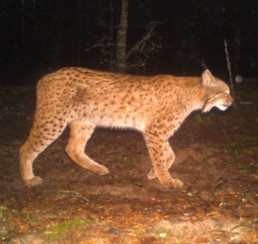
From October 2020 to March 2021, we carried out a targeted camera trapping monitoring of the Eurasian lynx (Lynx lynx)in three biodiversity hotspots in Ukraine and Belarus, including the Ukrainian Chornobyl Exclusion Zone (CEZ), where 65 trapping sites were researched. This species is a key large carnivore of the region with a protection status, yet still poorly studied. The survey provided the first scientifically based assessment of the Eurasian lynx population in the CEZ. It turned out quite high – 1.54 individuals/100 km2. The researchers suggest that the relatively high density of lynx in the CEZ is due to its large area, abundance of prey, and low anthropogenic pressure. The work carried out and the results obtained are groundbreaking for the region and serve as a basis for further research on local Eurasian lynx populations and their conservation.
The data collected by means of camera traps helped the researchers to analyse the most suitable habitats for the Grey wolf (Canis lupus) in Polesia, taking into account ecological and anthropogenic factors. The study published in 2023 proves that the CEZ, with its almost total absence of anthropogenic pressure on wolves, is one of the core protected areas for this species in the region.
In 2024, a study was published, analysing the diurnal activity of wolves and lynx across areas with varying levels of human disturbance. The point was to reveal the correlation between anthropogenic pressure and animals’ temporal behaviour. The data obtained through camera trap monitoring in the Chornobyl Exclusion Zone formed a crucial part of this study: this area is a rare example of a vast territory where large predators encounter virtually no human presence, meaning that the impact of anthropogenic factors on their behaviour and way of life is minimal. The researchers found out that wolves in all the study sites were more nocturnal than diurnal. As expected, wolves in our baseline study area in the CEZ showed the highest levels of daytime activity. At the same time, lynx in the Chornobyl Exclusion Zone were not the most likely to be observed during the day. The data obtained indicate that the nocturnal habit of the lynx does not depend on the type and level of human disturbance.
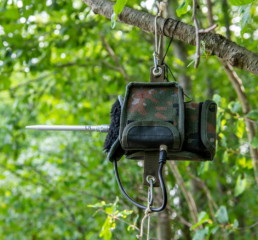
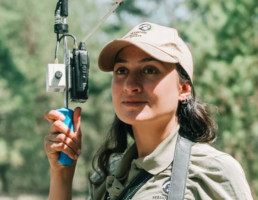
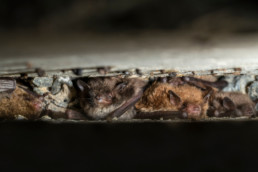
Camera traps are an important and effective tool for monitoring wildlife. However, they do not capture the full diversity of species inhabiting natural landscapes. That is why we have adopted another innovative tool in Polesia – passive acoustic monitoring. 40 sites were surveyed in the Chornobyl Exclusion Zone. This survey method targets cryptic, nocturnal and poorly studied species such as bats, small mammals and stridulating bush crickets that are difficult to monitor in traditional ways. This technique has proven invaluable for tracking the distribution and activity of the area’s “hidden” biodiversity.
As part of the project, we did not merely conduct one-off studies of biodiversity in the Chornobyl Exclusion Zone; we also contributed to the long-term, targeted, and systematic study of wildlife in this fascinating area. We provided a range of support to the Chornobyl Biosphere Reserve by supplying high-quality monitoring equipment, such as binoculars, scopes, and mobile phones. We introduced the SMART monitoring system, facilitating data collection and information exchange between the staff. Our experts organised training on the use of the provided equipment in fieldwork for scientists and rangers. For long-term monitoring of the local wildlife, camera traps have been installed across the Chornobyl Biosphere Reserve (Ukraine).
Wilderness on fire
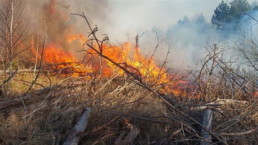
Polesia is one of the Eastern European landscapes predicted to be threatened by the growing frequency of devastating landscape fires. This is driven by both climate change and human factors, in particular, large-scale peatland drainage and deforestation. However, the area suffers from wildfires already today. Realising the pressing character of the problem, our experts analysed 5,338 large fires that occurred in Polesia throughout the 19-year period, from 2001 to 2019. They included the fires in the Chornobyl Exclusion Zone – especially dangerous, taking into account the heavy contamination of the area.
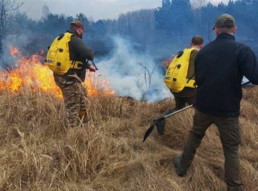
The authors of the study came to the conclusion that in the exclusion zone, under high moisture levels, relatively small areas were damaged by fires even in the territories where fuel load was high. In turn, the drier northern and southern parts of the Chornobyl Exclusion Zone are more prone to fires. The researchers insist that maintaining and restoring natural hydrological regimes, primarily rewetting of degraded peatlands, is seen as the most effective measure to make the landscape more resilient to extensive fires. This study became another piece of evidence in favour of wetland restoration, including in such a special area as the Chornobyl Exclusion Zone.
On the way to restoration
As part of our project, we have identified several sites for the restoration of wetland ecosystems in the Ukrainian Polesia region. Two of these sites are located within the Chornobyl Exclusion Zone – these are the Uzh river floodplain in the Chornobyl Biosphere Reserve as well as the Osliv River catchment and drainage system in the Drevlianskyi Strict Nature Reserve. Apart from the aforementioned resilience of the landscape to wildfires, we expect that the restoration will also help to support biodiversity through restoration of ecosystems, mitigate climate change and prevent soil erosion. The latter effect is especially important in view of heavy contamination of the area.
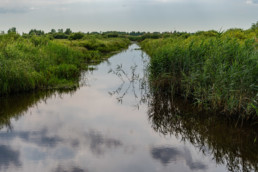
The restoration work was preceded and will be accompanied by continuous, long-term monitoring of both hydrological and ecological conditions by means of modern satellite and automated measurement technologies. We are observing groundwater level fluctuations, water discharge in drainage channels and the dynamics of seasonal floods. The monitoring will play a key role in tracking the progress of the restoration and ensuring its success.
Elleni Vendras, the project leader:
"Project work in contaminated areas is especially challenging and requires flexible and innovative solutions."
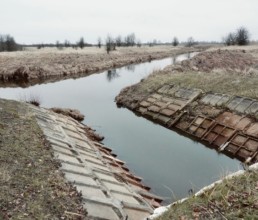
The high level of radioactive contamination is the defining feature of the Chornobyl Exclusion Zone, which necessitates a particularly thorough selection of restoration approaches. Radioactive contamination in the selected restoration site in the Chornobyl Biosphere Reserve is relatively low, allowing for earthworks to be carried out. It means that drainage channels can be blocked with the local soil. At the same time, in the Drevlianskyi Strict Nature Reserve, earthworks are not possible due to the high contamination of the area with long-lived radionuclides. The risks are high both to the environment, through airborne migration of radioactive matter, and to the health and safety of workers. Therefore, a different restoration method was chosen for this site, namely, closing the dams with wooden planks.
Another important factor we must take into account when working in the Chornobyl Exclusion Zone is that we operate under martial law. This area was directly invaded by Russian troops at the start of the war. As a result, landmines and unexploded ordnance are still found in the natural environment, posing a danger to the health and safety of the staff working in the CEZ. Consequently, our actions must be properly coordinated not only with the nature reserve’s specialists but also with the military administration, which affects the speed at which decisions are made.
Despite the challenges we face, we are continuing our work and moving forward, striving to ensure that the Chornobyl Exclusion Zone – a unique part of Polesia – poses fewer environmental risks whilst preserving its natural heritage as much as possible. The case of Chornobyl Exclusion Zone shows that nature needs space and time, therefore the expansion of protected areas is so much important for conservation of rare species and natural processes. So that we can give enough space to nature without catastrophes.


The project “Polesia – Wilderness Without Borders” is part of the Endangered Landscapes & Seascapes Programme and is funded by Arcadia. The project is coordinated by Frankfurt Zoological Society (FZS).