
Wins for Polesia in 2025: new accomplishments for conservation in the long term
Another year of hard work to preserve the nature of Polesia is behind us. Unfortunately, the circumstances of this work have not changed recently — Ukraine is still at war, which makes conservation activities more difficult. Nevertheless, we have a number of achievements to boast about, that are important not only here and now, but also for the long-term future of wildlife conservation in Polesia.
Wetland restoration in Ukraine: the field stage begins!
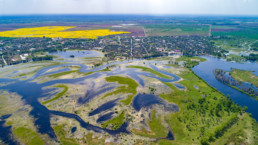
Last year, our focus remained on wetland restoration in the Ukrainian Polesia, specifically in the Chornobyl Biosphere Reserve (Chornobyl BR) and the Rivnenskyi Strict Nature Reserve (Rivnenskyi SNR). An important milestone was reached at the beginning of the year when we started the baseline assessment of the hydrological conditions at the restoration sites. Alongside the existing monitoring network, we set up several automatic measuring points equipped with state-of-the-art technology for the first time in Polesia. This monitoring will continue for at least ten years, providing data that will enable us to assess the effectiveness of restoration measures and make well-informed decisions in the future.
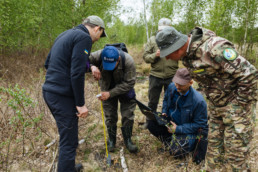
Meanwhile, engineering planning and environmental impact assessment procedures were underway in preparation for restoration work on priority sites covering over 13,000 hectares. Engineering plans for peatland and floodplain restoration in the Chornobyl BR and Rivnenskyi SNR have been finalised and are currently being approved. Based on current progress, we anticipate that construction work will begin in Q3 of 2026.
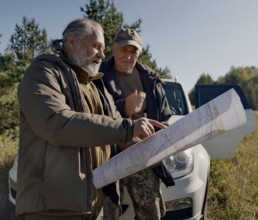
In parallel with this work, we identified two additional restoration sites in the Rivnenskyi SNR and Drevlianskyi Strict Nature Reserve (Drevlianskyi SNR). The scientific justifications for these sites have been finalised and approved, and we expect engineering planning to start in 2026. The restoration site in the Drevlianskyi SNR promises to be challenging: the reserve is partly located within the Chornobyl Exclusion Zone that is heavily contaminated by long-lived radionuclides. Earthworks are therefore not possible there, as they pose a high risk both to the environment and workers’ health. Therefore, a site-specific solution has been proposed: wooden dams will be used to block the reclamation systems through which water flows out of the territory. This will be implemented manually in 2026 upon receiving necessary permissions.
Enhanced protection for natural values
The efforts of our experts in lobbying on environmental issues continue to bear fruit in Belarus. In 2021, for example, our project developed a management plan for Pripyatsky National Park, which is one of the largest protected areas in Belarusian Polesia. The plan included expanding the national park and increasing its strictly protected zone, among other things. According to it, the area of Pripyatsky National Park increased by 539.59 hectares, bringing its total size to 89,092.59 hectares. The park’s strictly protected zone increased by 2,522.3 hectares and now covers 37% of its total area.
Before 2022, the scientific justification for expanding the Turaw Meadow Nature Reserve from 145 to 253 hectares was prepared. The proposal had successfully passed state procedures only in 2025 and public hearings, with approval expected in 2026. Although the reserve is relatively small, it is of exceptional importance for wetland birds, especially during the spring migration, when over 200,000 birds gather there simultaneously. Large flocks of spring of theses migrants remain there for several days to a week or more. Turaw Meadow is located in close proximity to the town and is affected by its surroundings. Therefore, it is crucial to extend the area under protection and ensure that adequate protection measures are in place.
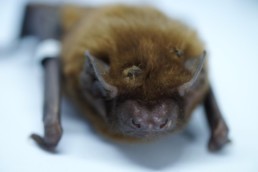
The new edition of the Red Book of Belarus was published in March 2025. The list of protected species is updated every 10 years. This time, the Giant Noctule (Nyctalus lasiopterus) was added to the list thanks to the project’s research until 2022 and advocacy efforts. Field research conducted as part of our project confirmed that the rare bat was present in Belarusian Polesia, despite it having been considered lost for several decades.
This finding provided the scientific basis for the Giant Noctule to be listed in the Red Data Book, subsequently leading to state-level protection measures.
For instance, the special protection regime for the bats’ habitat includes a ban on logging, removal or damage of trees containing mother colonies. Use of chemical plant protection products and economic activities are forbidden during the wintering period (15 November to 15 March).
In 2025, approvals continued to be given to place the habitats of rare species of flora and fauna in Belarus under legal protections, still based on proposals made before 2022. A total of 278 sites covering more than 40 species of flora and fauna and totalling 11,003.7 hectares were taken under legal protection in 2025. In addition, typical and rare biotope sites are now legally protected across a total area of 558.7 hectares. A further 211 protection passports covering more than 4,500 hectares are expected to come into force within the next two months.
Research shapes the future expansion of the protected areas' network
Expanding protected areas is one of the most effective ways to protect natural resources. However, this process must be consistent and well justified. In 2025, we received new scientific data that enabled us to identify and map priority areas for protection and restoration. This time, the data comes from a large-scale passive acoustic monitoring survey conducted as part of our project between 2019 and 2022. It was the first time that the occurrence and distribution of elusive species such as bats, nocturnal birds, small mammals and bush crickets, had been analysed in Polesia. The dataset obtained during the survey formed the basis of the study. Statistical modelling was then used to create detailed maps predicting the distribution and activity levels of the studied species across the 151,000 km² study area. The analysis revealed the extend to which these animals depend on the existing network of protected areas and identified territories of potential importance for conservation.
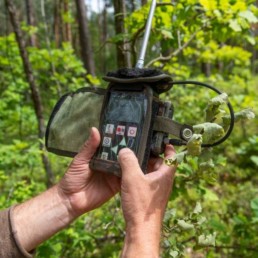
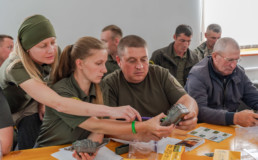
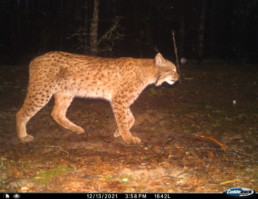
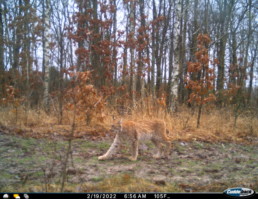
Meanwhile, more advanced research tools are also being used widely to survey Polesia’s biodiversity. For example, camera-trap monitoring is ongoing in all eight project key areas, and protected area staff have been trained to independently collect and manage the data. In summer of 2025, a series of capacity-building training sessions were held for staff working in the project’s key protected areas. Seventy-six rangers and scientists learnt how to deploy and retrieve camera traps, and how to collect, manage and analyse the resulting data.
They were also trained in SMART (Spatial Monitoring and Reporting Tools) monitoring. This tool offers many advantages for biodiversity monitoring and data organisation. Previously, rangers had to walk long distances through Polesia, making notes of their observations in a notebook. Now, with a mobile device and the SMART application, they can photograph and document rare plants, animals, illegal activities, and unusual natural phenomena. The system automatically saves the coordinates and enters the information into a central database that is accessible to other specialists. Staff in nearly all key project areas were provided with new camera traps and mobile phones with the SMART application installed to enhance the effectiveness of their work researching the biodiversity of Polesia. Our project team continues to work closely with protected area staff on data collection, management, and analysis.
Targeted support for efficient operation
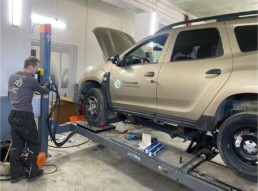
In 2025, the measures funded in Ukraine focused on providing targeted support to protected areas to strengthen their operational capacity and ensure long-term nature conservation. This included financing 25,000 litres of fuel for patrols and research trips, as well as repairing 33 vehicles. Rangers and scientists were also provided with the necessary equipment, including 150 camera traps, 100 smartphones and other monitoring equipment. They also received modern communication devices to enable them to coordinate emergencies more quickly and pass on information efficiently within the protected areas.
Another key point was the assumption of emergency costs, which enabled rapid and efficient assistance in critical situations. This included providing firefighting equipment and transferring seven fire trucks, carrying out urgent repairs in protected areas and purchasing and installing a solid fuel boiler to ensure a safe heating supply in the Drevlianskyi Nature Reserve administration building.
Overall, these measures strengthened the protected areas in Ukraine making a lasting contribution to preserving biodiversity in the region and strengthening the resilience of protected areas in the face of future challenges.
Spreading the word about the value of Polesia
The value and significance of Polesia’s natural values is a topic that never gets old. In recent years, the importance of the region’s wetlands has taken on new meaning in the context of the ongoing war. The bogs are now considered not only for their natural value and environmental services, but also as a factor in national security, providing an additional natural barrier against military invasion. The full-length documentary “Natural Border”, produced by Suspilne — one of the largest TV channels in Ukraine — presents different views on the phenomenon of the Polesian bogs. The film highlights the ongoing restoration efforts implemented by the Frankfurt Zoological Society, and the lives of people in Ukrainian Polesia.
Another step in raising awareness of the natural values of Polesia is to develop official websites for so far three protected areas involved in the project. Many existing websites of natural protected areas in Ukraine are either outdated or inactive due to unpaid hosting fees. We hired experts to develope the design and structure of the sites according to the recent brandbook for Ukrainian protected areas, and prepaid the hosting fees for several years. In future, the protected areas’ staff will maintain and update their web resources themselves. This will help to disseminate urgent and reliable information directly from those on the ground, who are best placed to represent their areas and provide local news. This will raise the profile of the protected areas of Polesia in both the regional and national information spaces and help to reach a common standard of protected areas in Ukraine.
Dissemination of knowledge about natural values and nature conservation via educational courses was a part of the project’s work in 2025. Throughout the year, our experts prepared and conducted five online courses focusing on the development and implementation of ecological trails, tracking and monitoring techniques for mammals, supporting the conservation of biodiversity near protected areas and promoting rural biodiversity conservation, insect biology, behavior, and ecology, rescue and handling of wild animals. Protected area staff, staff of regional ecological offices, teachers as well as other interested parties, 260 people in total, attended the courses giving very positive feedback to the facilitators.
2025 has seen the continuation of the systematic work that has been ongoing for several years. Many of this year’s achievements have also made significant contributions to the long-term vision of sustainable, consistent, science-based conservation activities in Polesia.




The project “Polesia – Wilderness Without Borders” is part of the Endangered Landscapes & Seascapes Programme and is funded by Arcadia. The project is coordinated by Frankfurt Zoological Society (FZS).