

Listening to the landscape: what the groundbreaking acoustic monitoring survey reveals about the biodiversity of Polesia
As the global biodiversity crisis worsens, it becomes increasingly important to obtain as much reliable data as possible on the occurrence, distribution, and habitats of different species. Many areas of high conservation value remain understudied due to a lack of resources, the vastness of the areas, and the extreme difficulty and time-consuming nature of surveying elusive or rare species using traditional methods. Experts believe that passive acoustic monitoring (PAM) could be an effective solution to this problem. A new paper based on acoustic data from Polesia has been published. Data collection for this study was conducted as part of our project.
The potential of PAM for large-scale biodiversity surveys is recognised. However, it is rarely used in conservation practice due to a lack of knowledge about how to collect and analyse these types of datasets. Additionally, technologies for the automatic processing of PAM data have only recently begun to emerge. Despite its impressive potential, the authors of the new paper point out that there are still few studies using PAMs capability to collect data on multiple taxanomic groups, and no published studies on using PAM data to prioritise conservation efforts at landscape scale.
The acoustic survey in Polesia was the first of its kind in the region and an important step in studying this landscape of exceptional conservation value. Although the network of protected areas here is extensive, there are still many gaps. In the case of Polesia, the designation of protected areas is usually based on data covering a limited range of well-studied species. At the same time, the ‘hidden’ biodiversity of this region includes many species that are much harder to find and study. Nevertheless, these species are numerous and undoubtedly play a significant role in maintaining the balance of the region’s ecosystems. This new survey collected for the first time in Polesia, valuable data on the distribution and activity of cryptic, nocturnal and poorly studied species such as bats, small mammals and stridulating bush crickets. These species are often neglected in biodiversity monitoring due to the time and labour required to survey them. The obtained data helps to answer two important questions: Does the existing network of protected areas really safeguard these populations? Where should future efforts to protect the Polesian wilderness be focused? The multi-taxa approach implemented is vital because many of the aforementioned understudied species are threatened by human activities and the fragmentation of natural areas, yet are seldom considered when conservation strategies are planned.
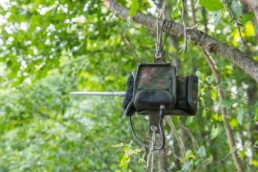
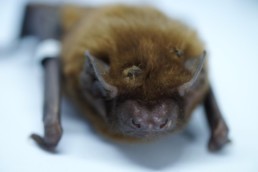
During the acoustic survey conducted in 2019-2022, sound recorders were deployed at 506 sampling points across the Ukrainian and Belarusian part of Polesia. All in all, 2884 nights of data were obtained, which equals 34,000 monitoring hours. Using a combination of machine-learning and subsequent additional manual verification, the team of experts identified 644,543 vocalisations from 15 bat species, 6,130 vocalisations by six species or groups of small mammals, 17,153 stridulations from 17 bush cricket species, and 99,902 vocalisations from 13 species of nocturnal birds.
The researchers then used statistical models to create detailed maps predicting the distribution and activity levels of these species across the entire 151,000 km2 study area. The authors also analysed how the distribution of these animals overlap with the existing network of protected areas and highlighted the territories that are potentially the most important from a conservation point of view. These are the areas supporting a great diversity of species or being critical strongholds for animals that are threatened with extinction, either globally or within Europe.
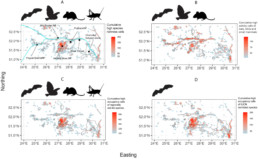

When mapping the distribution of the target taxonomic groups, the researchers took the locations of nationally protected areas and Emerald Network sites into account. They analysed the overlap between the strongholds of the surveyed species and areas with a protection status.
Their analysis confirmed the effectiveness of nationally protected areas: the existing national parks and nature reserves in Polesia support a greater variety of birds and bats, as well as a higher levels of acoustic activity (a proxy for abundance) for most of these species, compared to similar unprotected land. This suggests that the current protected area network, originally designed to safeguard well-known species, is already providing critical, previously undocumented benefits for the region’s lesser-known wildlife. This evidence powerfully reinforces the idea that legal protection status, with all its mandatory practical measures, is one of the most effective tools for conserving biodiversity.
However, a critical finding emerged: between two-thirds and nearly 90% of the biodiversity hotspots detected are located outside the current protected area network. This shows a significant gap. According to the research, an estimated 14,000 to 16,000 additional square kilometers of land would need the targeted conservation measures for each animal group.
The maps created during the study help to identify and prioritize new areas for protection, especially those that serve as key habitats for multiple species at once. The PAM data proves that Emerald sites are associated with high concentration of bats and small mammals and their high acoustic activity. Unfortunately, this category of natural areas designated in Ukraine now lacks legal protection and practical conservation measures. This study is an argument for focusing future lobbying efforts on these sites to safeguard these abovementioned taxonomic groups – which in turn support their predators and the broader ecosystem.
The authors of the study emphasise that PAM demonstrates high efficiency in terms of the ratio of resources expended to the amount and value of the scientific data obtained. Despite the challenging terrain and lack of road access in Polesia, each field worker can deploy five to ten acoustic recorders in one day. Unlike traditional research methods, this work does not necessarily require species-specific knowledge and and can be carried out by volunteers or non-experts. Over 500 sites can be surveyed in less than 200 days of fieldwork, including the deployment and collection of recording devices. At the same time, PAM provides a relatively straightforward means of obtaining data on multiple taxonomic groups simultaneously, including rare, cryptic and nocturnal species that are typically understudied. It enables rapid mapping of the distributions of multiple species across extensive and understudied landscapes. These data can be used for a variety of purposes, such as site-based conservation, long-term population monitoring, phenology studies and restoration efforts assessment. Combining PAM with traditional research methods can produce especially impressive results. The new opportunities are very important for conservation practices not only in Polesia but also globally.







The project “Polesia – Wilderness Without Borders” is part of the Endangered Landscapes & Seascapes Programme and is funded by Arcadia. The project is coordinated by Frankfurt Zoological Society (FZS).